
The eCRM Playbook: Best Practices for Cleaning Up and Scaling
Many organizations rely on eCRM platforms to power donor engagement, retention, and digital fundraising. But whether you’re migrating into a new eCRM system or trying to untangle years of complicated workflows inside your current one, long-term success depends less on the platform itself and more on the operational foundation behind it.
Your organization’s eCRM is a powerful tool. But over time, even well-managed systems can become cluttered, inconsistent, or outdated, making it harder to scale effectively. Before building new journeys or layering on additional complexity, it’s a good idea to take a step back and do a little “spring cleaning”.
If you get the fundamentals right, you can have a sophisticated engine with a clean structure for growth.
Below, we’ve mapped out a practical playbook for setting up your eCRM to support stronger engagement, better deliverability, and more sustainable program management.
1. Get Your Data House in Order Before You Start to Decorate
Don’t rush into a migration. Take the time to ensure that you’re bringing clean data into a new system.
Audit and de-duplicate your contact records before migrating any record. Many eCRMs bill by contact volume, so duplicates end up costing your organization money. More importantly, inconsistent records can distort reporting, fragment donor experiences across campaigns, and create confusion when building journeys and segments down the line.
Define your data model early. Map out your key constituent attributes, donation history, program interests, and engagement level before building out how they interact. A strong structure upfront makes it significantly easier to scale campaigns, reporting, and personalization over time.
Set up Data Extensions as your foundation, rather than separate audience lists. Start with a master contact table (universal audience), engagement history, donation or transaction history, preference data, and suppression records. This creates a centralized framework that is easier to maintain and reduces the likelihood of conflicting audience logic across campaigns.
Define and use a single unique contact key from day one. Link your data extensions to a single contact key to avoid billing and duplication issues later.
Establish naming conventions at the start and maintain a centralized data dictionary. This is the difference between a scalable system and one that only a single person can navigate.
2. Segment With Purpose
Your eCRM lets you slice your audience in a hundred ways. The organizations that succeed are the ones who segment strategically, not exhaustively.
Modern email performance increasingly depends on engagement quality, not audience size alone. Organizations that continue sending broadly to disengaged audiences often experience declining inbox placement, weaker response rates, and higher levels of donor fatigue.
Start with your core segments:
Donor groups (active, lapsed, mid-level, and sustainers).
Program participants (e.g. event attendees).
Advocates and newsletter-only subscribers.
Inactive/suppression list.
Build engagement-based segments. Internet Service Providers reward senders who consistently reach active audiences. Segmenting by recent opens, clicks, and engagement protects your sender reputation, and, most importantly, improves your inbox placement.
Suppress long-term inactive records. It feels counterintuitive to shrink your list, but it's how you protect the health of the contacts who matter most.
Score before you send. Build a simple engagement score using open rate, click rate, and donation recency. Use it to prioritize your most responsive audiences before major campaigns.
Use your platform’s automation tools to keep segments fresh. Schedule regular refreshes to update donor lifecycle status and manage suppression rules automatically. You'll thank yourself later when you’re not doing these manually!
3. Launch Journeys in the Right Order
Don't try to automate everything at once. Over-automating too soon is one of the most common mistakes organizations make and one of the hardest to unravel.
Start with two or three core journeys that solve clear business needs before expanding into more advanced automation. Overbuilt ecosystems often create a web that becomes increasingly difficult to troubleshoot, maintain, or optimize over time.
High-priority journeys to launch first:
Welcome journey for new donors.
Lapsed donor re-engagement series.
Preference center.
These foundational automations typically deliver immediate value while helping teams build confidence in how data flows throughout the system.
Always test within the sandbox first. A misconfigured entry event in a journey can flood inboxes instantly.
4. Monitor the Metrics
These are the numbers to track closely after migration:
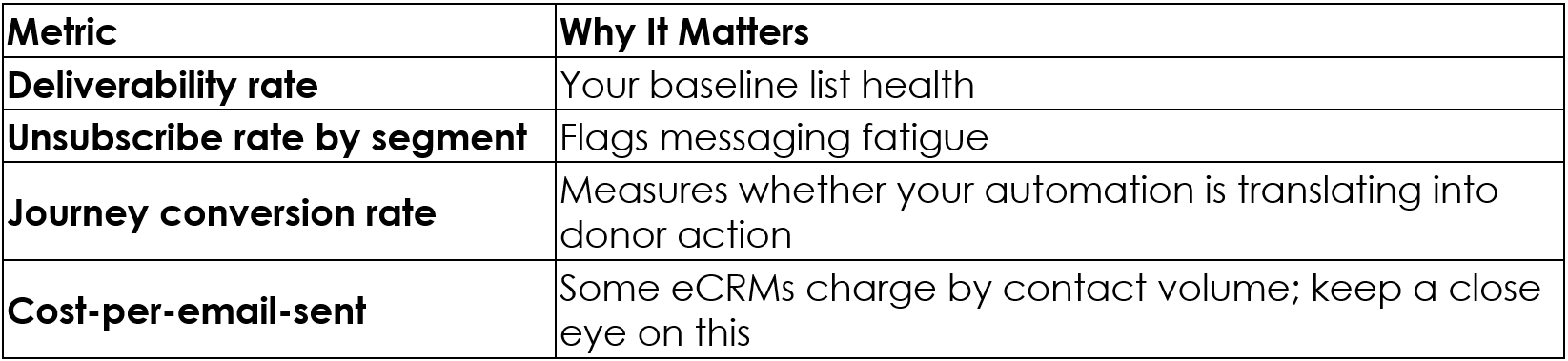
Monitoring these metrics consistently after implementation can help teams identify issues early before they become larger operational or performance problems.
The Foundation Matters
Whether you’re preparing for a platform migration, reassessing your current systems, or simply trying to create more clarity and scalability across your fundraising and engagement programs, taking the time to build a strong operational foundation pays off in the long run.
At the end of the day, the right structure can improve efficiency, strengthen performance, and make it easier for teams to adapt as strategies evolve. If your organization is navigating growth, change, or complexity, we’d love to connect!

About the Author
Becky has spent the last decade mastering the art of direct response fundraising. When she isn't crafting compelling campaigns, you can find her adventuring with family or lost in a good book.